

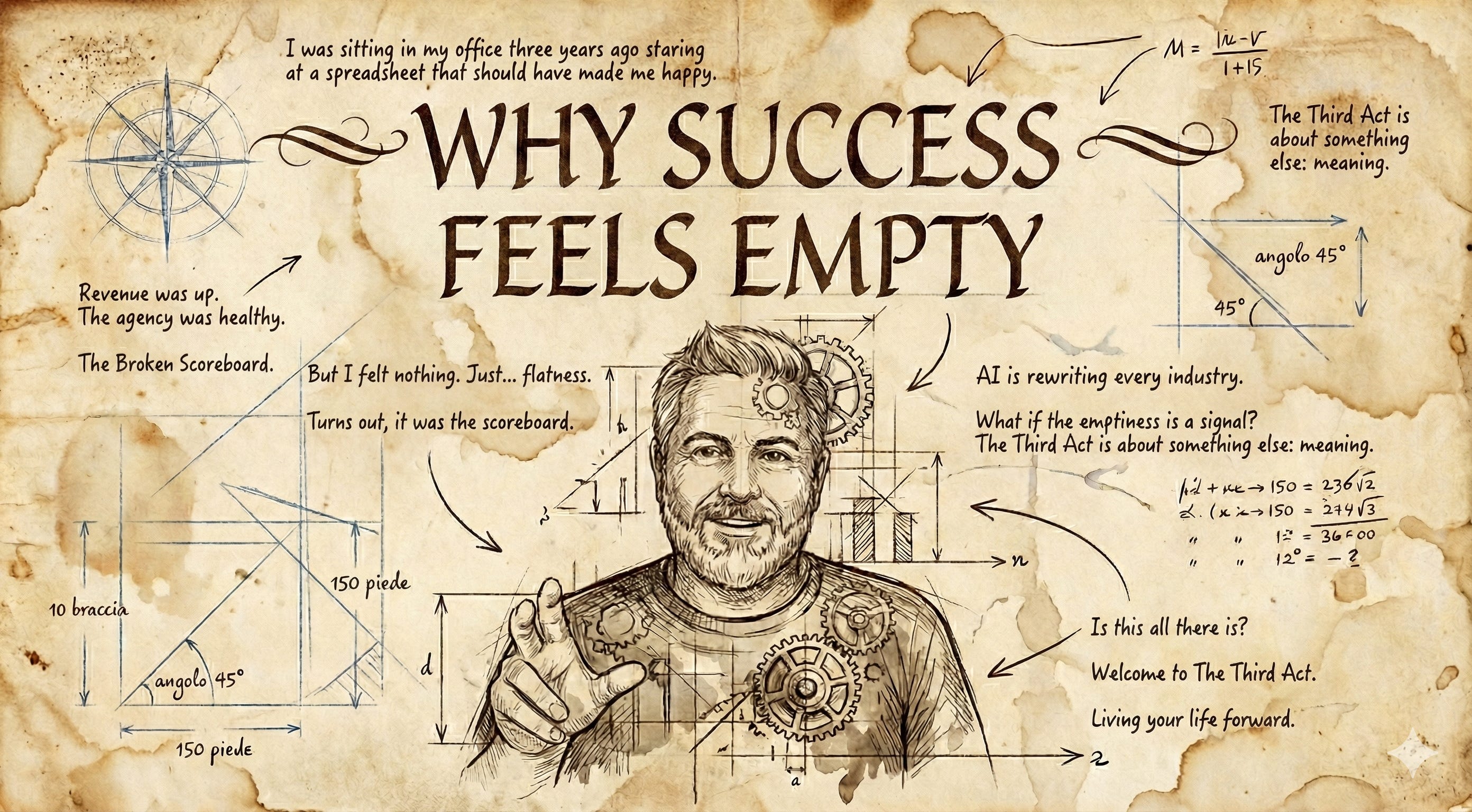
I was sitting in my office three years ago staring at a spreadsheet that should have made me happy.
Revenue was up. The agency was healthy. Clients were paying on time. By every metric I’d chased for 24 years, I was winning.
But I felt nothing.
Just... flatness. Like I’d climbed a mountain only to discover there was no view at the top — just another mountain that looked exactly like this one.
I thought something was wrong with me.
Turns out, it was the scoreboard.
The Broken Scoreboard
For 40 years, I had a scoreboard. And it worked.
Title. Income. Team size. Revenue. Close the deal, see the number go up. Hit the target, feel the win.
Simple. Clear. Addictive.
But somewhere along the way, something shifted. I hit the number... and felt nothing. The dopamine stopped showing up. I was still winning by every measure I’d set for myself — but the scoreboard didn’t light up anymore.
At first, I thought I was broken. Then I looked around.
It wasn’t just my scoreboard that was broken. The game itself changed.
AI is rewriting every industry. The skills that made us successful are being automated. The economy that rewarded our experience is transforming faster than anyone expected. And the people teaching you about it have never built anything outside of a laptop.
The Trap of Being Good at Something
Here’s the trap: you’re really good at what you do.
That sounds like a blessing. It’s actually the problem.
For decades, being good was the goal. You worked hard to get competent. You got competent, you got opportunities. You got really good, people started counting on you.
Being needed felt like winning. And it was — for a long time.
But then you kept doing it. Not because you loved it, but because people depended on you. They expected it. And you couldn’t imagine stopping because — who are you if you’re not the person who does that thing?
That’s the Competence Trap. And here’s what makes it dangerous right now:
The skills that trapped you? They might not exist in five years.
The role you’ve perfected? AI might be doing it cheaper and faster.
The identity you built around being “the person”? That person’s job description is being rewritten as we speak.
The Emptiness Is a Signal
What if the flatness isn’t a problem? What if it’s your instincts telling you the old playbook is broken?
What if the people who thrive in the next decade are the ones who stopped staring at the old scoreboard and built a new one?
That’s the question I sat with for a long time. And then I stopped sitting with it and did something.
What I Did About It
I didn’t hire a life coach. I didn’t take a sabbatical.
I built something.
I took the thing that was supposed to replace me — AI — and I made it work FOR me. I built an AI assistant that handles my email, manages my calendar, tracks my health, and briefs me every morning before I touch my phone.
I didn’t do it because I’m a developer. I’m not. I did it because I was drowning in the WRONG work — the busywork, the noise, the stuff that kept the old scoreboard ticking but didn’t move my life forward.
When I automated that noise, something happened. The flatness started to lift. Not because the AI fixed my purpose — but because it gave me back enough time and mental space to actually face the harder questions.
So I kept going.
I started training after decades of ignoring my body. I’m rebuilding from scratch — home gym, real programming, working around a heart condition I earned from years of not paying attention.
I went back to a pen-and-paper journal after every digital system failed me. Turns out, the practice of writing by hand is the practice of paying attention.
I handed my agency to my son-in-law and stepped into a role I’d never played: the architect instead of the operator.
The AI fixed my schedule. But it was just the start. What came after was rebuilding everything.
The New Scoreboard
The old scoreboard measured what you accomplished.
The new one measures how you live.
Am I healthy? Am I present with my family? Am I building something that matters to me — not just to my clients? Am I spending my hours on things I chose, or things that chose me?
That’s a different game. And it requires different tools.
If You’re Feeling This
If you read this and something hit — the flatness, the “now what,” the sense that the old scoreboard doesn’t work anymore — you’re not broken. You’re awake.
The question is what you do next.
I’m documenting everything I’m building — the AI systems, the health transformation, the business shifts, the experiments, the failures. Step by step. Every week. So you can build it too.
You don’t need a map. You need better tools and someone a few steps ahead showing you what’s working.
That’s what this is.
— BG